How to score more in Crazy10s
Every line adds up to 10, so the points come from how many lines one move finishes, where the big numbers land, and what you leave for your opponent. Here is what strong players look for.
Play Crazy10sFree in your browser. No sign-up needed. New to the game? Read the rules first
One move, several lines
Each line your tiles finish is worth 10. The score of a move is mostly the number of lines it finishes.
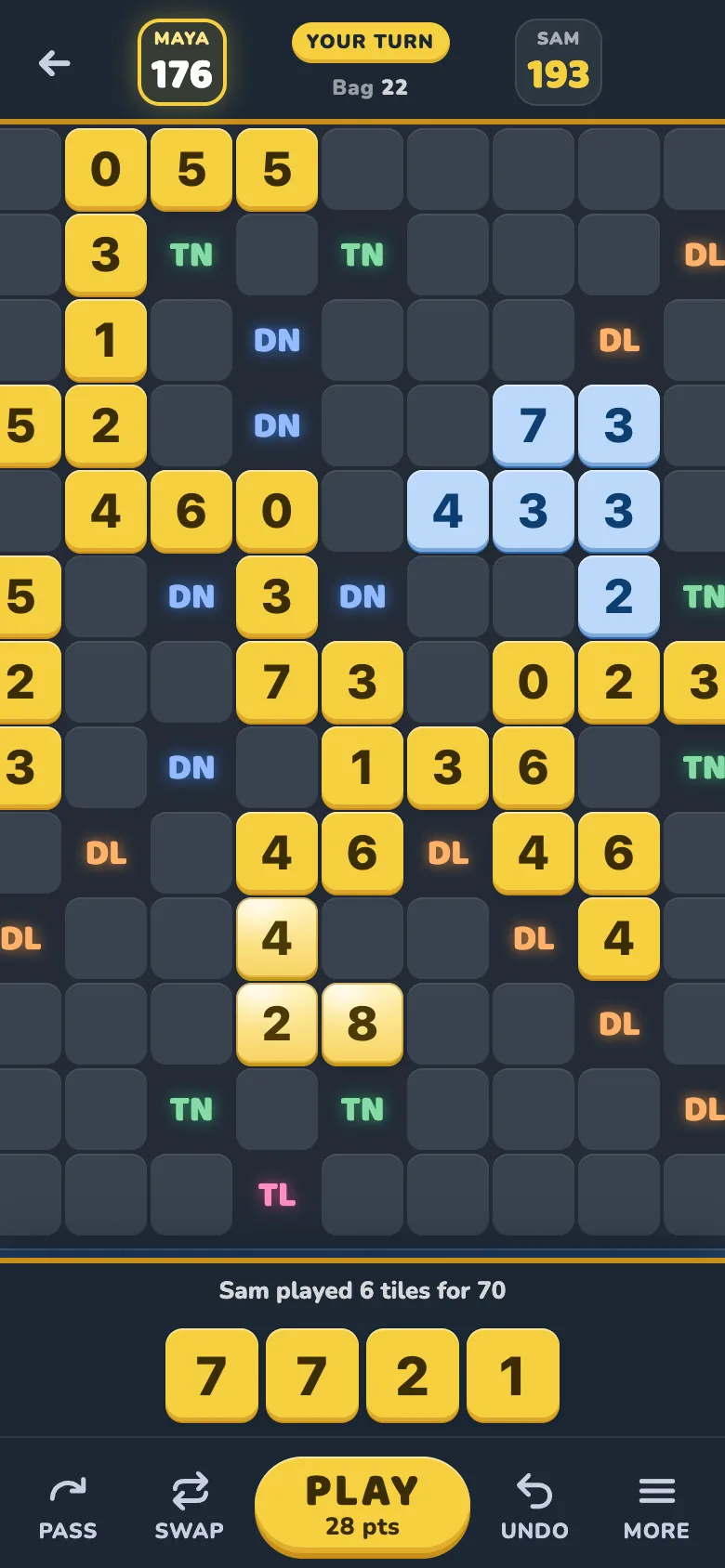
A single tile dropped on the end of a run makes 10 points. The same tile placed where a row and a column both need it makes 20. The strongest everyday move is the parallel play: a short line laid alongside a line already on the board, so that every tile you place finishes a short column as well as your new row.
already on the board your tiles
Before you play, scan the board for pairs that already make 10 or need one more number: a 4 next to a 6, a 3 with a gap before a 5, a lone 9 waiting for a 1. Every one of them is a line you can finish without spending many tiles. Then ask whether the tiles you are about to place can finish a second line on the way.
Big numbers on tile multipliers, any line on a line multiplier
The coloured squares never change whether a move is legal, only what it scores. A tile multiplier applies before the line multiplier, in every line that tile is in.
So the rule of thumb: put your biggest number on a tile multiplier, and reach a line multiplier with any line you can. A tile multiplier counts in both lines when the tile sits at a crossing, which is where it pays the most. The squares on the board you are playing are listed under How to play inside the game; the classic board has a +50 in each corner, a line-triples square in the middle of each edge, and rings of doubles and triples around them.
The zero is a tool, not a score
A move that places one 0 on its own scores nothing, so a 0 can never be dropped beside a finished line to take its points. Inside a move, though, the 0 is one of the most useful tiles you have: it extends a line that already makes 10 without changing its sum, which lets you reach another tile, a multiplier or an open square.
already on the board your tiles
Hold the wild tile for the move that needs it
The ★ plays as any number from 0 to 9. On an ordinary line it earns exactly what a normal tile would, so it is wasted there. It earns its keep when it is the one number a big move is missing: the 9 that goes on a tile-triples square, the tile that reaches a corner, or the digit that makes a third line add up while two others already do. Keep it until a move like that appears, unless the bag is nearly empty.
In the Daily Puzzle you always hold exactly one ★. Treat it as the last tile you decide: build the move with your six numbers first, then see which digit the ★ needs to be to finish one more line.
Your rack: pairs, and the trouble with 8s and 9s
Learn the pairs by heart: 1 + 9, 2 + 8, 3 + 7, 4 + 6, 5 + 5. A rack with two or three pairs in it almost always has a good move. The bag is weighted toward small and middle numbers, with only two 8s and two 9s in 80 tiles, which is why those two are the hardest tiles to place: an 8 needs a 2, or a 1 and a 1, and a 9 needs a 1 or a ★. Play them as soon as a line can take them rather than carrying them to the end, where they count against you.
Swap when the rack is dead. A swap ends your turn with no score, which feels expensive, but a rack of 8 8 9 9 7 7 0 can cost you three or four weak turns in a row. Swap the high numbers, keep the ★ and the pairs. Remember that six scoreless turns in a row end the game, so don't swap or pass more than you must near the end.
Think about what you leave behind
Every tile you place is a tile your opponent can build on. A 4 placed one square from an open corner hands them a 6 for 60 points. A line that ends right beside a line-triples square invites a 30-point reply. Before you commit, look at the squares next to your move and ask what one tile from a full rack could do there. When two moves score the same, play the one that leaves less.
The reverse is also true: a 9 at the end of a line is hard to extend (it needs a 1), and a line that already makes 10 can only grow with a 0. Finishing a line with a high number closes that part of the board a little.
All seven tiles: +20
In a game, a move that places all seven tiles from your rack earns 20 extra points on top of the lines it scores. It happens more often than it sounds, mostly as an opening or as a long line across open board with a 0 or two in it. The Daily Puzzle doesn't award it; its scores stay comparable day to day.
The endgame: watch the bag
The bag count sits under the turn indicator. Once it reaches zero, the first player to empty their rack ends the game and adds the value of the opponent's remaining tiles to their own score; if neither player has a legal move, or six scoreless turns pass, the game ends with each player's leftover tiles counted against them. So in the last few turns the question changes from "what scores most" to "how do I get rid of my tiles, highest first". A 9 in hand at the end is a 9-point swing against you; a 0 is free.
Plan the last two or three turns together: if your opponent is down to one or two tiles, dump your big numbers now even for a small score, because they may end it next turn.
The Daily Puzzle: one move, three tries
The Daily is the same rule with no opponent: one board, seven tiles (six numbers and a ★), three tries, your best counts, and the highest possible score shown to chase. The best moves are almost always five or six tiles that finish three or four lines, often a parallel play beside a row that is already there, with the ★ as the digit that makes the last line work. Use the first try on a solid move, then spend the other two hunting for one more line. If a corner or a line-triples square is reachable, start the search there.
Every past puzzle and its best move is in the archive; reading a few of them is the fastest way to see what a 150-point move looks like.
Questions
Short answers about scoring and strategy.
How do I score more than 10 points in one move?
Finish more than one line. Every line your tiles touch scores 10, so a tile that completes a row and a column at once scores 20, and a row placed alongside an existing one can finish three or four lines in a single move. Multiplier squares add to that.
Should I play the wild tile as soon as I get it?
Usually not. It can be any number, so it is worth the most on a turn where it lands a big number on a tile multiplier, reaches a corner, or finishes a move that scores several lines. Spent on an ordinary 10-point line it earns the same as any other tile.
When should I swap tiles?
When the rack has nothing that scores well and no pairs that make 10, for example two 8s and two 9s with no 1s or 2s. A swap costs the turn, but forcing a weak move and keeping a dead rack can cost several.
Why did my 0 score nothing?
A move that places a single 0 on its own scores zero, wherever it lands. A 0 placed as part of a move with other tiles scores normally, and it is useful: it can stretch a finished line toward another tile without changing its sum.
Does the +50 corner square get multiplied?
No. The +50 is added once, on top of the line scores, and the line multipliers never touch it. It pays for any move that covers the corner except a single 0 on its own.
What is a good score in the Daily Puzzle?
The Daily shows the highest possible score for the day, so measure yourself against that. The best moves are usually five or six tiles that finish three or four lines; a move that scores two thirds of the highest possible is a strong result.